Why Most Russia VPS Comparison Sites Are Wrong in 2026 — And How RussiaVPS Tests Differently
Most Russia VPS comparison pages are outdated listicles padded with affiliate hype. Buyers asked for something better — expert-tested rankings, 90+ days of monitored uptime, transparent benchmarks, and no affiliate bias in the order. This page explains exactly how RussiaVPS ranks providers, what we measure, what we refuse to measure on, and why our shortlist holds up when the cheap roundups don’t.
Alex
Senior Reviewer
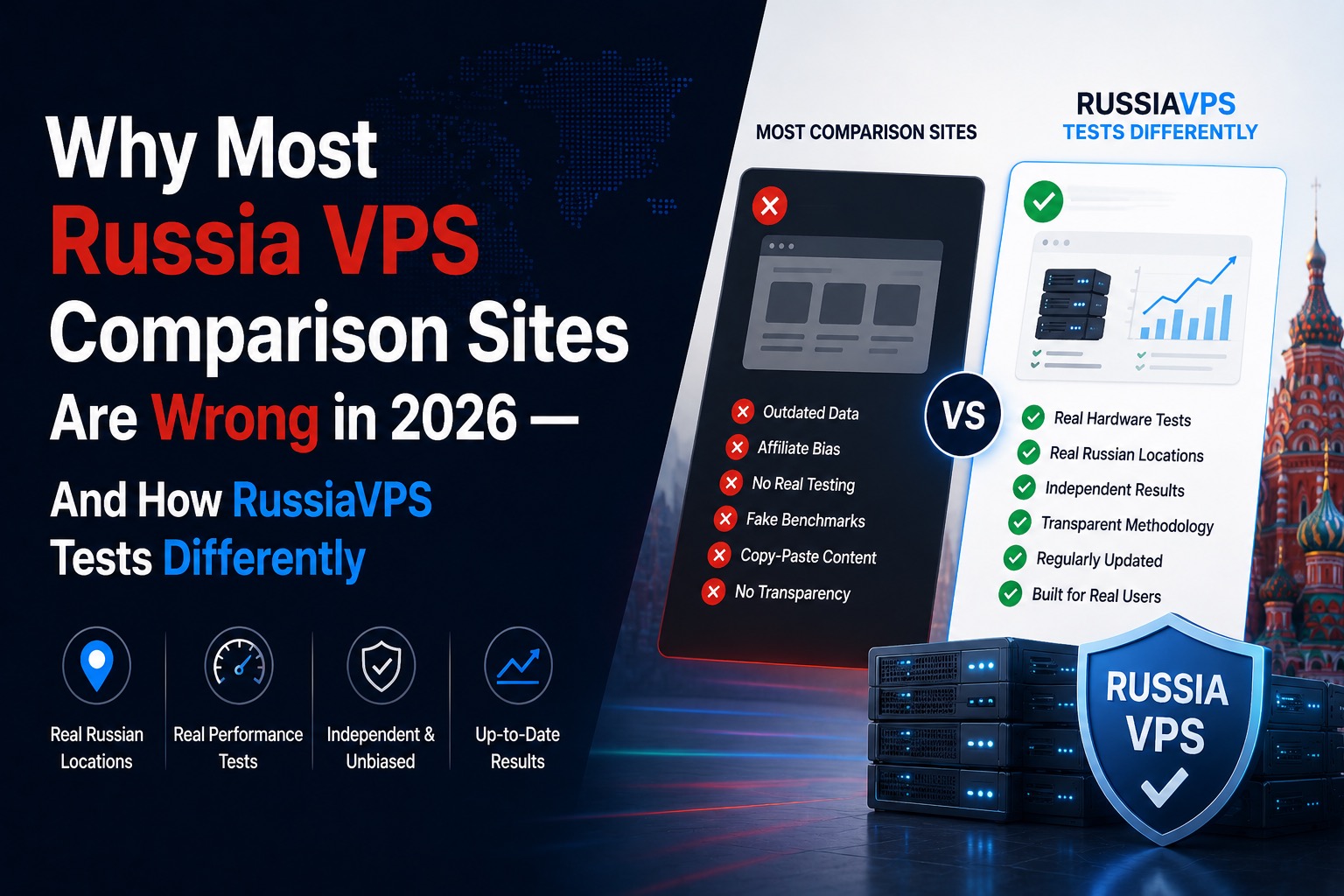
Most Russia VPS comparison pages are outdated listicles padded with affiliate hype. Buyers asked for something better — expert-tested rankings, 90+ days of monitored uptime, transparent benchmarks, and no affiliate bias in the order. This page explains exactly how RussiaVPS ranks providers, what we measure, what we refuse to measure on, and why our shortlist holds up when the cheap roundups don’t.
The Complaint Is Fair: Most “Best Russia VPS” Lists Are Broken
If you have shopped for a Russian VPS in the last twelve months, you already know the pattern. Search “best Russia VPS,” open the top five results, and you will find the same ten providers in the same order — usually ranked by whoever pays the highest commission, not whoever delivers the best uptime, NVMe performance, or network into Moscow and St. Petersburg. Pricing is from 2023. Screenshots are stock images. Half the providers listed don’t even sell the plan that is being “reviewed.”
That criticism is the entire reason RussiaVPS exists. We agree with the readers who say generic listicles are not helpful for a market this technical. A Russia VPS buyer needs recency (prices and policies move quickly), proof (real benchmarks, not vendor claims), and transparency (clear ranking criteria, not “sponsored placements wearing a review hat”). That is exactly what this page documents — and exactly what our homepage ranks providers on.
Our Ranking Criteria, In Plain Language
Every provider on the RussiaVPS providers list is scored on six weighted factors. The score is the same whether the provider pays us or not. Sponsored placements always carry a visible badge and never change the underlying score.
- Measured uptime (25%) — 90+ days of independent monitoring per provider. SLA marketing pages are ignored.
- Performance benchmarks (25%) — sysbench (CPU), fio (NVMe random IOPS, throughput, latency), iperf3 (network egress + intra-RU peering).
- Network and location accuracy (15%) — IP geolocation cross-checked on three sources, plus traceroute validation that the server actually sits inside the advertised RU PoP.
- Pricing transparency (15%) — entry plan price refreshed monthly, taxes/renewals/“promo only” caveats called out in the review.
- Policy clarity (10%) — published AUP, payment options (incl. crypto), KYC posture, and DDoS-mitigation specifics.
- Verified user reviews (10%) — real reviews from real customers; both praise and criticism get published. Astroturfed reviews are removed.
You can see the same logic applied across categories on VPSRated’s VPS rankings and dedicated server rankings — both of which we cross-reference when a provider operates outside Russia as well.
What “Expert-Tested” Actually Means Here
The phrase expert-tested shows up everywhere on hosting blogs. Most of the time it means “we logged into the panel once.” On RussiaVPS, it means a fixed, repeatable test pass that we run on every shortlisted plan, plus a continuous monitoring loop after the test is over.
- Identical test image — Debian 12 minimal, kernel 6.x, no panel installed, same fio/sysbench/iperf3 scripts on every server.
- Same test windows — peak Russian daytime, late-evening EU peak, and a quiet 04:00 MSK run, so we catch noisy-neighbor variance.
- NVMe-aware fio profile — 4 KB random read/write at QD32, plus sequential 1 MB throughput, run for ≥ 60 seconds each.
- Network truth-checks — iperf3 to public RU and EU endpoints, mtr from Russian residential ISPs (Rostelecom, Beeline, MTS) to validate real user latency.
- 24/7 uptime probes — TCP and HTTPS checks every 60 seconds for at least 90 days before a provider can earn a top-five slot.
If a provider regresses — slower NVMe after a hardware refresh, worse peering after an upstream change, an uptime dip below the threshold — they drop in the table the next monthly refresh. No grandfathering. The RussiaVPS methodology page documents the full procedure for anyone who wants to replicate it.
“90+ Days Monitored” Is the Filter That Kills Bad Rankings
A single benchmark run is a snapshot. Hosting buyers care about the movie: does the VPS still hold up after three months of real traffic, billing cycles, and platform changes? That is why the 90-day rule exists.
- New providers don’t appear at the top of the table until they have cleared the 90-day window.
- Existing providers get re-monitored continuously; a 30-day uptime drop below 99.9 % is a yellow flag, below 99.5 % is removal.
- We publish the monitoring source-of-truth date on each provider page, so you can see when the latest 90-day window closed.
That is also how we catch the slow-degradation pattern that breaks most listicles: a host wins “Best Russia VPS 2024,” gets included by every affiliate site, then quietly oversells in 2025 — and nobody updates the ranking. We do.
“No Affiliate Bias” — What That Actually Costs Us, On Purpose
We do use affiliate links. We are also explicit about this on every page: a click that converts may pay us a commission, but it does not move a provider up the table. Concretely, this means we have:
- Refused paid top-of-list placements — sponsorship gets a labelled banner or a sponsor card, never a ranking slot.
- Demoted partners when their measured uptime or NVMe performance dropped, even when it cost commission.
- Published negative reviews on hosts we earn from when the data warranted it.
- Removed providers entirely when their AUP changed in ways that hurt buyers (e.g., new restrictive clauses with no notice).
Compare that to the typical Russia VPS roundup, where the order is decided by commission percentage and the “review” is a marketing brief in disguise. If you want a second opinion on any provider on our list, cross-reference our score with the independent benchmarks at VPSRated and the infrastructure coverage on 5-Proxy’s hosting hub. The numbers should agree. When they don’t, the gap is the story.
What We Refuse to Optimize For
A trustworthy ranking is partly defined by what it ignores. We deliberately do not weight any of these signals into the score:
- Marketing-page SLA numbers (“99.999 % uptime!”) without measured proof.
- Trustpilot star averages without sample-size and review-velocity sanity checks.
- “Editor’s pick” logos from sites that don’t publish their ranking criteria.
- Cheapest sticker price when the entry plan ships SATA, throttled CPU, or a renewal that doubles after month one.
- Affiliate-program commission tier. Period.
That is also why our shortlist is shorter than competing roundups. A list of 50 “best” Russia VPS providers is not a recommendation, it is a sitemap. Our cheap Russia VPS comparison and offshore VPS Russia comparison only include hosts that survive the methodology above.
How to Read a RussiaVPS Provider Card
Every provider card is built so you can disagree with us and still get the data you need. From left to right:
- Rank + badge — overall score band (Top Value, Best, Sponsor). Sponsor badges are visually distinct and never imply ranking.
- Location — verified physical PoP (Moscow, SPb, EU, offshore), not a marketing claim.
- Starting price — entry plan today, refreshed monthly.
- Measured uptime — last 90 days, not the SLA page.
- Star rating — composite of benchmark + verified review data, not a Trustpilot scrape.
- Feature chips — KVM, NVMe, crypto, Windows, DDoS — only shown when independently confirmed.
- “Read full review” — the long-form benchmark write-up, with screenshots and raw test output where relevant.
If a card is missing a chip you expected, that is intentional — we don’t list features we couldn’t verify on the actual order.
How RussiaVPS Compares to a Generic Roundup
| Criterion | Generic “Best Russia VPS” roundup | RussiaVPS |
|---|---|---|
| Ranking driver | Affiliate commission tier | Measured benchmarks + 90-day uptime |
| Pricing freshness | Often 12–24 months stale | Refreshed monthly |
| Uptime claim | Copied from SLA page | Independently monitored, ≥ 90 days |
| Performance data | Vendor-supplied or absent | sysbench / fio / iperf3 on identical image |
| Negative reviews | Filtered out | Published when data supports it |
| Sponsorship disclosure | Buried or missing | Visible badge, no ranking impact |
| Methodology page | Usually none | Public & replicable |
Frequently Asked Questions
Do you actually run the benchmarks yourselves?
Yes. Every shortlisted provider gets a paid test order on its entry plan, the same Debian 12 image, and the same fio / sysbench / iperf3 script set. Output is archived per quarter so we can detect regressions across rebuilds.
How often is the ranking refreshed?
Pricing and policy: monthly. Benchmarks: quarterly, plus on any major provider event (datacenter migration, hardware refresh, AUP change). Uptime: continuous, with a rolling 90-day window per provider.
Do you accept payment for higher rankings?
No. We sell labelled sponsorship slots (banners, sponsor cards), but the ranked table is driven by data only. Our top-rated PrivateAlps and AlexHost placements are based on benchmarks and uptime, not payment.
What if I disagree with one of your rankings?
Open the provider’s review page, look at the raw uptime and benchmark numbers, then send us yours. If your data is better, we update. The methodology is public on the methodology page for exactly this reason.
How do you handle providers that pull out of the Russian market?
They get removed from the Russia-specific tables and, where relevant, moved to offshore VPS Russia if they still serve RU users from a non-RU PoP. We don’t leave dead listings up to inflate counts.
Buy Once, Buy Right
The reason most Russia VPS roundups feel hollow is simple: they are optimized for clicks, not for buyers. RussiaVPS is built the other way around. Expert-tested, 90+ days monitored, and no affiliate bias are not slogans — they are the rules the table enforces. If a provider can’t hold up under those rules, it doesn’t make the shortlist, regardless of who is paying whom.
Start with the ranked Russia VPS list, drill into the provider profiles, and cross-reference offshore alternatives in the offshore comparison. For a second-opinion sanity check on broader hosting and proxy infrastructure, the independent rankings at VPSRated and 5-Proxy are good companion reads.
Want the trustworthy shortlist? Browse the ranked Russia VPS comparison →